Before leaving Newcastle and riding on the worst road of our adventure so far, there were a few things we needed to do. The first was to sing the praises of Lilly Pilly (Syzygium) fruit that we collected daily from the abundant street trees in Newcastle.
They were a particular favourite of Woody's.
The second was to catch up with an old mate, Chris Brown – a fellow artist, community gardener and super-fermenter. Here Chris is pouring us a glass of his awe inspiring home brew made from ingredients foraged within 500m of his home: dandelion, ginger, nettle, sugarcane and bramhi (
Bacopa monnieri).
Thanks Chris! The third was to celebrate Zeph's twelfth birthday, with a cake he made himself,
and tickets to his first big concert –
Macklemore and Ryan Lewis – who just happened to be in Newcastle on Zeph's actual birthday.
The next morning it was away to the Stockton Ferry for we concert-weary folk, bidding adieu to all the sweet peeps we met and stayed with, high from the gig and the generosity of Novacastrians.
And we rode northeast away from the city, along a loud and crazed Nelson Bay Road stopping for respite after forty odd kms at the beautiful Noamunga Reserve where we brazenly pitched our tents,

much to the chagrin of one local who took exception to Zeph rabbiting for dinner with our fold down bow. He'd obviously been watching far too much tele and mistook a boy's joyous quest to live off the land for something dark and threatening. The two policemen who came to our camp told us rabbits are protected wild animals and we were in a National Park. Really? We thought rabbits were considered an environmental menace and therefore the sort of animal we should be hunting. Silly us. We were also challenged for camping on public land, and in no uncertain terms were told by the policemen they had the interests of the nearby property owners to protect. Oh boy, even what's left of the commons is subject to private property policing. We're obviously so naive regarding the imperatives of the state. We were however allowed to stay the night and woke up to this beautiful morning for our troubles.

A little rattled by the previous day's ride and the previous night's interrupted hunt and camp we headed to Nelson Bay to find a permissible place to spear fish, which was not easy in a marine park.
Ah, now we're starting to get it. We're illegitimate on public roads, on public land and in public waters. I think the law makers are trying to tell us something:
don't move around without causing shit loads of pollution; don't free camp, you'll piss off the legit land owners and caravan park operators and don't try to eat off the land and be accountable for your resources, we don't want to upset Woolworths, Coles, Monsanto et al. Feeling a little depressed and feeling the strain of all this illegitimacy we turned again to the self-governing
Warm Showers website and found this lovely couple, Brian and Doris, not far from where we were.
At very late notice Brian and Doris put us up for the night and we all slept soundly in their beautiful treetops home. Recharged and with a bag full of their home-grown produce, we rolled down to the ferry that was to slowly take us across Port Stephens to Tea Gardens.
We asked one of the crew if they knew of anywhere we could free camp.
Try Winda Woppa Reserve, there are always free campers there. Great, a community of illegitimates, sounds like home, we just need to get across the drink to Hawks Nest.
So we crossed the Singing Bridge on our day's song cycle and travelled for several kilometers around to Winda Woppa past Hawks Nest where we put Woody down for a sleep among the freeloaders and mosquitos.
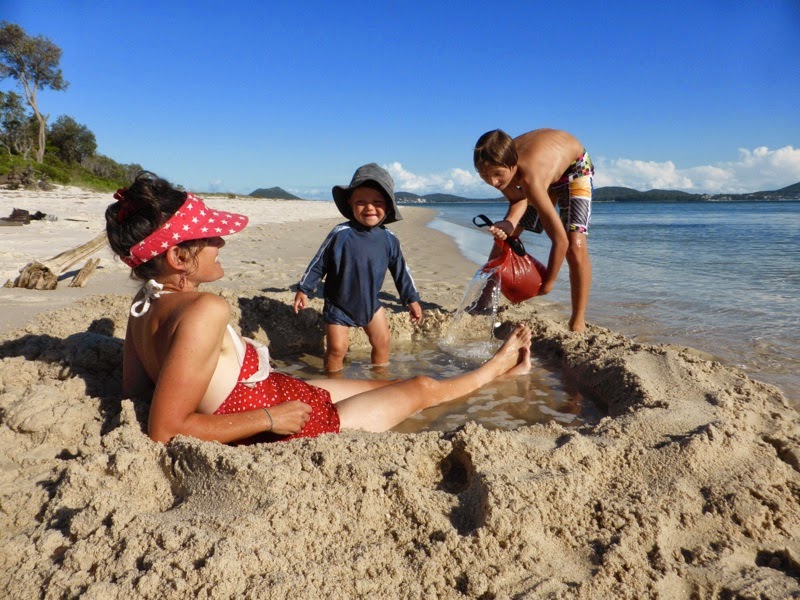
We found a camp site just in the bush from this gentle beach, perfect for spear fishing flathead and playing in the sand.
We camped a few days here as predators eating fish and as prey being eaten by sandflies and mosquitos. Inadvertently we became textile makers too. Zero and another dog found a recently killed rabbit and brought it to us.
By the smell of it this little being had been dead for quite a few hours and its death was quite a mystery. It was a good opportunity to give the boys an impromptu rabbit skinning workshop. Zero lucked in on the meat and offal as we skinned and scraped, washed and hung the pelt out to dry. After a couple of hours drying a labrador came onto the beach, found the pelt and gobbled it whole. That put an end to making a little fishing tackle pouch, but it certainly enlivened our thoughts about the value of such skins.
For our last breakfast at Winda Woppa we had porridge on the beach. With cooler autumn days, camp fires will become more and more possible. We packed up camp in a crazed shooing sandfly dance and legged it to Bulahdelah along the Pacific Highway.
It was in Bulahdelah we found a great little public park with BBQ facilities, so we cooked dinner with some locally bought produce and we set up the
Artist as Family correspondence office,
before making camp at what we thought was a legit free camping spot on the Myall River.
However, it turned out that this was a free camping ground for RVs and caravans only. Our legitimacy was a momentary illusion derived by refusing to read the prohibition signs.
We can't have tents messing up the town, geez, we might attract unwashed types. Terrible stuff! We camped there anyway.
This anti-tent fascism sent us a clear message to move on. We had only come to this inland town because there was no coast road to follow. We left Bulahdelah, 12m above sea level, and climbed east up and down to this point of The Lakes Way, 165m asl, where we stopped for a fruit break.
Coming down the hills by the heavy weight of our bikes was exhilarating and we rested for the night at Boomerang Point at another sneaky camp spot that we found. The following morning we got chatting to a mum and her kids who were on their way to school. She asked us where we had stayed and we didn't beat about the bush. She then told us she was the local ranger and kindly invited us to camp at her place next time we were in the area. Thanks Katrina, you could have thrown the book at us, but instead you showed compassion and encouraged our travels.
A gentle flattish morning ride from Boomerang Point brought us to Forster. We hung out at the library for the afternoon putting Woody to sleep under a desk before heading down to the beach for a swim.
While at the library we met Glenn, a fellow cyclist and (we found out later) the council's general manager. He kindly invited us back to spend the night with himself, his wife Maryanne and son James. They cooked us a bonza meal, provided us with beds, showers and laundry and an opportunity to discuss the not-so-meritorious history of Monsanto from DDT to Agent Orange to GM foods. There's change in the air and it's no longer infused with Roundup. Thanks for your generous hospitality Glenn and Maryanne!
James, who is a student by correspondence, told us about
The Tank, a place his older brother goes to spear fish. Despite an empty catch bag it was a snorkeling treat with a multiplicity of marine life all responding to the dramatic effects of waves and their tidal gods.
We liked being in this town and decided to spend another night in the area, so we crossed the exceedingly long Forster-Tuncurry bridge in search of a place to make camp.
We swam and fished and cooked up dinner before setting up our sneaky camp behind some bushes in a municipal park near to this very convenient public BBQ.
Everything was going swimmingly in our hidden camp spot until 1am when a series of pop-up sprinklers woke us and Meg and Patrick were up 'til all hours holding the rotating jets away from our gear.
While packing up the next morning we met a bunch of friendly volunteers from Tuncurry Dune Care who were weeding out Asparagus fern. This is Carl, who, with fifty or so others, has been aiding the restoration of the dune ecology in the area for more than a decade. We asked Carl if Asparagus fern is edible. He wasn't sure although told us it was related to the edible
Asparagus officinalis.
As we have a passion for being the biological controls of domineering species, we were keen to find out the benefits of this invasive plant. Our initial online research was inconclusive, some saying the plant's berries are toxic to humans as well as to cats and dogs, and some saying the little starchy tubers are no more toxic than the tips of raw
Asparagus officinalis. Certainly you could collect enough of the small starchy tubers in a short time to make a meal. We'll do some more investigation and get back to you on this one.
Another thing we have a passion for is passing on knowledges. Zeph has become a keen fisherman on the trip and here he shows Woody how to attach bait to a hook,
and here how to collect wood for fire or cubby making.
After another morning's fish we rode with our catch to Redhead (near Black Head) and found a perfect camp spot – flat ground, shade, privacy and drinking water nearby.
We cooked the fish on the beach,
before Zero gave Patrick a sound critique of his first draft
Bulahdelah–Boomerang Point Holiday Family Cycle, the title ripped from
Les Murray's magical redneck poem of a similar name. We have our friend
Michael Farrell to blame for this grumpy greenneck poem in its infancy.
Patrick was made even more grumpy at Redhead when the fully loaded and very long tandem fell over while the front wheel was stuck in an inadequate sized bike rack, radically buckling it. ****! Then, just as we were deciding what to do, as if sent from the cycle gods themselves, local resident David Coyle wandered up to us. He was fascinated to see another tandem bike just like the one he rides; a bike he went halves in with his 80 year old neighbour who is now blind. What a joy it was to come back to David's home, meet his two girls Isabel and Lucy, their Isa Brown chooks,
listen to the story of his and neighbour Walter's tandem escapades, and stay in a little garden bungalow that David built from reclaimed materials.
The next day David took the buckled wheel with him to work in Taree and got the rim straightened at his local bike shop, enough so as we could get to Taree for further repairs. Thanks David, Lucy and Isabel, your home is certainly a sanctuary.
Despite all the by-laws and prohibition signs that constantly negate the possibility for sustainable travel, we are only able to do it with the help and love of people who share our common values and embrace our spirit for adventure.