Showing posts with label free camping. Show all posts

Sunday, 15 November 2015

Picking up and setting down new and old friends (from Violet Town to Jingellic)

Leaving David Arnold's highly productive Murrnong Farm was difficult. We worked for a few days within a (micro) global village where kid goat feeding, beer bottling, pancake and sourdough making, elder flower champagne producing, last season's chestnuts into hummus creating, mulberry picking and orchard netting activies flowed between stories and laughter and shared meals. Thanks Dave, Nils, Benny, Shyeni and Coufong.


Not wanting to burn ourselves out early on this 20 event book tour in 90 days, we rode to the Violet Town train station and made use of the bike and dog friendly train services again before they dry up in NSW. NSW Rail don't allow non-human kin on their trains (with the exception of assistance dogs, and bikes, annoyingly, have to be flat packed meaning that's it's a ridiculously big job to undertake as bike parts have to be taken off and specialty tools and excessively large cardboard boxes have to be carried.) We arrived in Wangaratta and headed onto the Wang to Beechworth rail trail. We visited the same abundant Mulberry tree as we did in 2013,


and hunted the same (possibly) Charlie carp in one of the creeks. He outcarped us again.


Taking off again in spring has many advantages. New possibilities for life are everywhere and we are lead by a general atmosphere of renewal.


We made camp at the disused community tennis courts at Everton Station,


and landed at our guest digs in Beechworth,


at Pete and Anni's place. They'd heard of our travels and got in touch. Thanks so much kind hosts and kind dogs!


Meg and Woody helped out in their veggie patch,


while Patrick helped Pete sort out the felled radiator pine into useable parts,


before we all had a wash, Woody in his typical fashion.


Our book event in Beechworth comprised of a lovely crowd, hosted by Diane at her excellent independant bookshop.


On the way out of Beechworth an invitation to stay in Wodonga was shouted from a passing car, and although we quickley exchanged social media handles, we were headed for Yackandandah to stay with Warm Showers hosts Matt, Michelle and Tarn. Sadly Matt had left for work before we took this photo:


We were a perfect match with this family. Woody and Tarn soon became good mates,


and so did we with a portion of the town folk. What a darn friendly village Yack is!


We had a second night down by the Yackandandah Creek,


before pushing off the next day and copping our first puncture.


Woody wants to know everything and asks his parents a thousand questions every day. Not quite a thousand answers, his parents have much to learn too, such as, what is this fruit? Is it a parasite, a geebung or wattle nut?


With air back in all four tyres we treadlied to Albury where a dude Patrick used to play football with at university lives and invited us to stay. Patrick hadn't seen Mick for over 20 years and hadn't been in contact and what's more we didn't even get to meet him as he was away for work. We stayed with his gorgeous wife Bernie and tenacious teen Paris and they embraced us like long lost kin. Thanks Bernie, home from a morning's run!


And thanks Mick, who hooked us up with the Border Mail to do a story. He also insisted we get in touch with pollinator guru and local permaculturalist Karen Retra and her man Ralph,


and we were given a tour of their pollinator-friendly, south-facing 1/4 acre that is either all under food production, under habitat creation or both in the same breath.


Karen in turn hooked us up with ABC Goulburn Murray and we were interviewed at length about our adventuring before we collided with Roy, a cycle tourer from Japan.


Roy accompanied us to our 5th book event where we met a lively cross-section of local sustainability activists, permies and ecologists. What an awesome crew!


Our community friend Mara met us in Albury and we rode with her and Roy along the majestic Murray River Road crossing back into Victoria.


What a joy it was to ride with these happy bike-campers along such a quiet, almost carless road,


and to wake to such mornings.


To top it off our book was 'Pick of the week' in The Age and The Sydney Morning Herald.


We farewelled Mara at Kennedy's Reserve and Roy at Jingellic where he videoed an Artist as Family jam sesh,


before we settled in to one of the prettiest free camp sites in Australia, cooking up plantain, sow thistle and flatweed to add to the evening pasta, breakfasting on carp and dandelion coffee,


and generally hanging out, getting to know the virtues of the Upper Murray River.


We have much gratitute for those we meet along the way. Those who come to ride with us. Those who put us up for the night. Those that nourish us as food. The roads we travel. The fellow campers. The community of the living that fuels all this possibility.

Monday, 9 November 2015

Another family of bicycle travellers

Recently, at the talk we gave at the Local Lives, Global Matters conference in Castlemaine, a woman approached us. We met Krista while we were cycling through Orbost at the end of last year. She and her family were planning a cycle touring expedition in France.

We often meet families who have travelled all the way to Europe where they perceive the roads are safer for, and the drivers kinder to, families on bikes. But after sharing with Krista a little of our experience, she and her partner Sam and their two youngsters, Daisy (two and a half) and Banjo (four), decided to tour a little closer to home.

As bicycle advocates wanting to spread the word of families on bikes, we invited Krista to be a guest blogger, to share her insights and anecdotes of her family's three month bike-camping adventure from April to June this year, from Goulburn to Urungu. Over to you, Krista Patterson-Majoor:
In the mornings we busy ourselves making breakfast, stuffing sleeping bags, and packing our belongings until the sun reaches us. More often than not, we seek the sun. One morning we cross a frost covered oval to bask in the warm glow. We make a bench seat from old fence rails and we sit silently, worshipping the sun.
We wear multiple layers while riding. Gentle uphill slopes are a blessing as they help us keep warm. Steep descents are torturous - the icy winds and misty rain collide with clenched fingers and squinting faces. There comes a moment when all feeling is lost. An unexpected warmth rushes through our rigid fingers. It's a feeling that brings memories of early morning newspaper delivery runs, another character building experience involving bikes.
In the evenings, we rely on each others body warmth to stay cosy. Daisy and Sam on the edges, Krista and Banjo in the middle. Three mats, three sleeping bags zipped together as one. Until Daisy stabs a mat with a tent peg. Fortunately it is repairable. On another occasion a Banjo and Daisy game splits a seam in a down sleeping bag. A cloud of feathers fills the tent. White fluff rushes up noses and into open mouths, causing hysterical laughter until we discover the source. On cold nights every single feather is important!
Some days we wake up and we don’t feel like riding, or packing the tent, or loading the bikes again. On days like these, something small often makes us realise how lucky we are to be where we are; a patch of sunshine, a quiet stretch of road, a Daisy song from the trailer, or perhaps another hour long Banjo story from the back of the bike. There’s also something bigger; the growing belief that cycling offers a unique opportunity to journey together as a family. 
No sooner than one journey ends, thoughts of others begin to grow. We're deeply impressed and inspired by the way in which Banjo and Daisy have embraced this journey, and grown as a result of it. As a friend from home pointed out '... they don't know they're little, and are supposed to be playing in the sandpit'. Although they may be little, they have played a big part. We think they make wonderful companions. We are thankful for having had this opportunity to spend so much time with them.
Thank you Krista, Sam, Daisy and Banjo for sharing your story. Happy riding! We hope lots more families follow in your wheel-paths. xx

Friday, 30 October 2015

Back on the road

We've been busy getting ready to leave, packing panniers, cleaning the house, planting out the garden for our tenants and for our return in three months' time. The two panniers that go on the front of Patrick's bike are our food and kitchen supplies. This is what's inside:


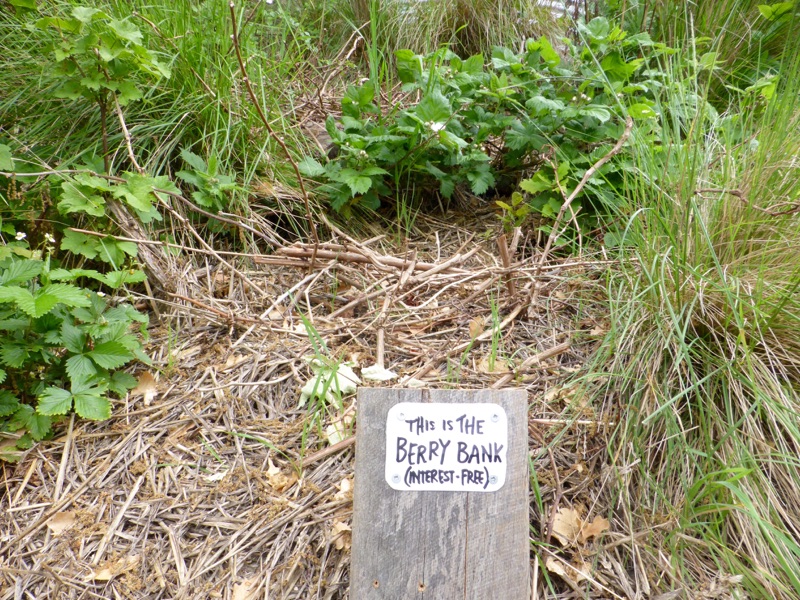
We've also been putting up little signs around the garden to aid the permaculture tour that is coming while we're away and also to help our tenants navigate the garden. Here's a selection:


It's a bit difficult to see how the swale works in the above picture so here's one from 2009 when it first went in. Water travels from our bath/shower along a spoon drain that has been plumbed level across the contour of the land. Water is distributed through 30 metres of food growing garden beds and 'passively' harvested deep into the ground. This is one way to help climate-change proof your garden. The whole system is gravity-fed.


We've also been harvesting our (unprecedentedly early) garlic,


bottling the last of our plum wine,


and much bike tuning.


Then we were off without the anxieties we felt on our first trip, heading east a gentle 22 kms with plenty of stops,


to our first hidey-hole camp in the wonderful Wombat Forest on the edge of Trentham.


We are not going to be blogging here as much over the next three months. We're going to be rather busy getting to 20 book events in 90 days. We will be micro-blogging however on Twitter, Instagram and Facebook, so please join us there @artistasfamily.

Wherever you are Dear Reader, we hope you'll check in with us along the way and share your thoughts, reflections, advice and even botanical knowledge. Which reminds us, does anyone recognise this plant? We came across it on the road between Daylesford and Lyonville.


Sunday, 14 September 2014

Eating ants, bush fruits and eels, and meeting crocodiles (Narragon Beach to Daintree Village)

It was very hard to leave our free-camping sanctuary with our freshwater pool streaming onto Narragon Beach just down from the Clump Point jetty where we pulled in our evening hauls of fish.


It was also hard to leave our lovely new and not so new friends.


We had our last ride in to Mission Beach with the delightful Tom Dean, the errant wayfarer, before once again setting our compass north.


Our restored senses went immediately into shock after we got back on the Bruce Highway. Trucks, motorhomes, caravans, misnamed 'eco' tourists, roadkill, roadside memorials, anthropogenic garbage and sugarcane mayhem all came flooding back to raze the peace and make us harden back up for another dose of digi-industrial reality. Needless to say we took the longer back road to Innisfail, via south Johnstone and Japoon, which rewarded us with this little haul of free fruit,


and a croc safe (at least in the dry season) swimming hole.


Further down the road we stopped to investigate some of the hidden ingredients in conventional banana farming.


This farmer was using two different pesticides: Echo 720, a fungicide and known carcinogen and the herbicide Gramoxone 250, which is an extremely dangerous chemical. The active constituent in Gramoxone 250 is paraquat dichloride, which is banned in 32 countries including China and all the EU nations including Switzerland where Syngenta, the chemical company that produces it, has its headquarters. This chemical has been linked to the development of Parkinson's disease.


What is incredible is that bananas are considered 'health food' in Australia! When we've been stuck for food and have had to resort to supermarkets on this trip we routinely ask one of the staff where the 'health food' and 'organic' foods are. These minuscule couple of shelves contain products that have too much packaging or are also packed with hidden nasties such as refined sugar.


To paraphrase Michael Pollan: If it comes from a plant eat it; if it's made in a plant don't. The sugar industry in South Johnstone had certainly made its mark on the town, the cane trains surge down the main drag like cocaine through a major vein.


We just keep thinking: what would it look like if the Queensland Government pulled its subsidies from cane farmers, taxed refined sugars like they do tobacco and transferred the revenue to organic food producers or farms transitioning to organic food, bringing the price of organic food down so as everyone could purchase it? Imagine the savings made to public health! Imagine the beautiful ruination of predatory pharmaceutical companies and irresponsible doctors who have built their businesses on an innutritious, immune depleting food system! And then there are the environmental questions.


Imagine if soils were no longer mined to grow a substance that isn't necessary and that is causing so much ill health. Can you imagine in these razed fields as food forests of Maccadamia nuts, Davidson Plums, paw paws, bananas, grapefruits, oranges and a hundred other fruits all grown as a polyculture with leguminous plants interplanted, used as chop and drop fertilisers, where thick humus would form, repairing the soil and its mycorrhizal strata, and where perennial groundcovers would spread out after the first years of pioneering annual weeds doing their work to repatriate the earth, where a billion organisms live and build soil structure, and who through rigorous competition fight off the threat of dominating species, so as no pesticides, no corporations making decisions about our health, no organic certification was necessary because agricultural pesticides were all banned and common sense prevailed? But for now this is the present: millions of acres of completely unnecessary sugar cane.


Because Woody has never had refined sugar, his taste buds are open to all foods and their sensations. Whereas we older ones in the tribe may have a few blue quandongs here and there, Woody seeks them out with a passion. He'll eat the tart ones, sour ones, mildly sweet over ripe ones, as well as the way past desirable ones.


He's becoming the most enthusiastic forager of us all. He's also partial to autonomus meat. At the free-camping spot at Babinda, Patrick hand speared a small black fish for bait and used it to catch this lovely creature on a 40-pound hand line:


an Australian long-finned eel (Anguilla reinhardti). We made a fire and cooked it on the coals for around 12 minutes each side. It was heavenly dining after peeling back the bitter skin and revealing the extraordinary white, moist flesh.


Artist as Family gave blessings to this powerful water creature and slept with the watery whirlings of the eel inside us. The next day we packed up early,


and took to the road. Our long-finned fuel powering us all the way into Cairns where we stayed with this delightful family:


Meet warm showers hosts Sarah, Oscar and Renee, who we look forward to spending more time with when we return to Cairns. After a night of great conversation, games, showers and delicious shared food, we picked up some supplies from the community food co-op and from a local park,


and headed north again. Sarah and Oscar rode ahead to steer our departure as Zero was having an RDO as our biological GPS.


One species that we have camped with everywhere, been stung by, admired their architecture but so far failed to try out as a bush food is the green ant (Oecophylla smaragdina).


These amazing fruitarians are everywhere and we've now incorporated them into our everyday diet as a robust free food species. Like whitchetty grubs they have a high fat content; perfect as a cycling fuel. They are a zingy citrus-like edible, which is not surprising as they love citrus. We have all, including Woody, learnt to catch them by the head with our pincers, killing them instantly and popping them whole into our mouths.


We only got as far as Smithfield, an outer suburb of Cairns, and Patrick's front wheel rim spilt open, possibly as a result of his eating too many green ants.


While waiting for the repairs we walked for a few hours in an industrial wasteland along the A1 and found these delicious ripe bush passionfruits (Passiflora foetida).


They oozed the devine right off the vine: no built religious environment was necessary to partake in this godly moment.


We were rather abruptly asked to leave the bike shop in Smithfield, prompting Patrick to write the following poem from our campsite at Unity Reef.

It felt right to be kicked out of the bicycle shop
in Cairns. We had coveted all their back room
power points with our touring stench. Baby and dog
running in and out of the place unsettling the gloss
while we waited for the expensive repair.
But perhaps it was really the ‘G20 - - - - LIES’
writ large across one of our tail panniers
that prompted the call for our exile by the boss.
After all the city was in feverish preparation
eager to celebrate the international visitors
with a cultural festival of entertainers
known as ‘the arts’.

Even if our schooling system today does its best to breed out the inquistive and critical in the population this doesn't mean that the forthcoming G20 bankers get-together in Cairns isn't a pox on the planet. But obviously many disagree, especially in Port Douglas where we came across this holidaying couple near the beach. When we asked the lady wearing it about her singlet she boasted it cost only $3 from K-Mart. Is it a joke? Are we missing the irony? Where do you start with such intransigence to life and the suffering of others for the sake of a $3 joke?


No doubt G20 finance delegates will flock to Port Douglas with all its monetary shmaltz. We on the other hand couldn't wait to leave, legging it back to the A1 after a picnic lunch with fake artisan bread, temporarily being split up by big sugar before the town of Mossman in Kuku Yalanji country, on the way to the Daintree.


Not far on we met this fantastic duo who were heading south and who are working on a very exciting bicycle touring project. It was lovely to meet you Simon and Alia!


Just nearby we found a laden grapefruit tree, loaded up, gave some to our fellow tourers before pushing on to find some ripe guavas, which we have commonly picked all along the east coast from as far south as Kempsey.


We camped the night at Newell Beach and the following day arrived at the village of Daintree.


Prone to regular flooding and therefore constant change the Daintree River is an ecological hive of activity.


We adults were as wide-eyed and excited as Woody when we saw fishing birds such as this pied cormorant (Phalacrocorax varius),


the numerous reptilian water critters such as this grand male estuarine crocodile (Crocodylus porous),


and these common tree snakes, sunning themselves.


While in the Daintree village we also learned more about Far North Queensland plant life, such as native taro (Colocasia esculenta var. aquatilis), which requires much lengthy preparation in order to make the tubers edible,


and Woody, completely unprompted, collected up all the Kuku Yalanji forest delights he knew including blue quandongs, satin ash fruit, peanut tree pods and hibiscus flower.


We were fortunate enough to meet Linda, a Kuku Yalanji elder, who was collecting freshwater mussels (Velesunio ambiguous) from the river. Linda told us that there are many important Aboriginal places around the village including a burial site that the local historical society is simply not interested in marking. Daintree village seems to be another case of white history told, black history conveniently disappeared.


We are resting up here for a few days, readying ourselves for the final northern leg, up the Broomfield Track to Cooktown, which is going to be quite a challenge from all accounts. We hope you are meeting all your challenges too, Dear Reader, and we thank you, once again, for joining us on our adventure.