Monday, 9 November 2015

Another family of bicycle travellers

Recently, at the talk we gave at the Local Lives, Global Matters conference in Castlemaine, a woman approached us. We met Krista while we were cycling through Orbost at the end of last year. She and her family were planning a cycle touring expedition in France.

We often meet families who have travelled all the way to Europe where they perceive the roads are safer for, and the drivers kinder to, families on bikes. But after sharing with Krista a little of our experience, she and her partner Sam and their two youngsters, Daisy (two and a half) and Banjo (four), decided to tour a little closer to home.

As bicycle advocates wanting to spread the word of families on bikes, we invited Krista to be a guest blogger, to share her insights and anecdotes of her family's three month bike-camping adventure from April to June this year, from Goulburn to Urungu. Over to you, Krista Patterson-Majoor:
In the mornings we busy ourselves making breakfast, stuffing sleeping bags, and packing our belongings until the sun reaches us. More often than not, we seek the sun. One morning we cross a frost covered oval to bask in the warm glow. We make a bench seat from old fence rails and we sit silently, worshipping the sun.
We wear multiple layers while riding. Gentle uphill slopes are a blessing as they help us keep warm. Steep descents are torturous - the icy winds and misty rain collide with clenched fingers and squinting faces. There comes a moment when all feeling is lost. An unexpected warmth rushes through our rigid fingers. It's a feeling that brings memories of early morning newspaper delivery runs, another character building experience involving bikes.
In the evenings, we rely on each others body warmth to stay cosy. Daisy and Sam on the edges, Krista and Banjo in the middle. Three mats, three sleeping bags zipped together as one. Until Daisy stabs a mat with a tent peg. Fortunately it is repairable. On another occasion a Banjo and Daisy game splits a seam in a down sleeping bag. A cloud of feathers fills the tent. White fluff rushes up noses and into open mouths, causing hysterical laughter until we discover the source. On cold nights every single feather is important!
Some days we wake up and we don’t feel like riding, or packing the tent, or loading the bikes again. On days like these, something small often makes us realise how lucky we are to be where we are; a patch of sunshine, a quiet stretch of road, a Daisy song from the trailer, or perhaps another hour long Banjo story from the back of the bike. There’s also something bigger; the growing belief that cycling offers a unique opportunity to journey together as a family. 
No sooner than one journey ends, thoughts of others begin to grow. We're deeply impressed and inspired by the way in which Banjo and Daisy have embraced this journey, and grown as a result of it. As a friend from home pointed out '... they don't know they're little, and are supposed to be playing in the sandpit'. Although they may be little, they have played a big part. We think they make wonderful companions. We are thankful for having had this opportunity to spend so much time with them.
Thank you Krista, Sam, Daisy and Banjo for sharing your story. Happy riding! We hope lots more families follow in your wheel-paths. xx

Thursday, 5 November 2015

Salsify days (from Trentham to Violet Town)

Salsify (Tragopogon porrifolius) flowers have been out in great numbers this year, lining the roads between Daylesford, Woodend and Kyneton. They are a great source of free food if you can identify them before they flower. By now the roots have become too woody to roast. The flower seeds however can be toasted and used in a salad and the petals make a great edible garnish.


We arrived in Woodend with an afternoon to relax before introducing ourselves to Woody, co-owner of New Leaves Bookstore. He had set up a prominent stand of our books before a nice little crowd gathered. Thanks Woody!


We were invited back to the Earthstar's home where we were treated to delicious food from their garden, a fine bed and the chance to enjoy Sam and Woody, both 3 years old, playing together. Thank you sweet family!


We left Woodend early attempting to beat the storms, but got wholly drenched anyway and thus reinitiated into the vagaries of cycle touring life. We loved it, especially as it remained warm and the ride along the old Cobb and Co coach road was quiet and virtually carless until we arrived in Kyneton and pulled up at Aesop's Attic Bookshop, greeted by the store owner, Clare.


From Aesop's we took a small group out on a foraging walk identifying over 20 edible species within a short walk from Clare's well stocked bookshop (that sells excellent books such as Dark Emu), 


before returning to give a reading and Q & A to a lovely bunch of book punters. Energised by our first two events we rode on towards Pastoria, coming across this wonderful signifier of chemical-company-embedded environmentalism — get your government-funded carcinogens cheap!


We made camp behind the Pastoria CFA,


slept soundly, woke up, had some breakfast, stretched down, 


took to the road and momentarily became muddled with all the possible routes we could take.


We've been finding this trip that if we have a few nuts and some dried fruit in the mornings, ride for an hour or two, then cook up a big billy of porridge we get away much earlier and do more riding in the coolest part of the day.


The road from Tooborac to Seymour was fairly uninteresting, punctuated regularly by roadkill in varying states of decay. When we arrived in Seymour we put Zero in a regulation travel box and for the first time we were all legitimate travellers on the state's public transport.


We got off a few stops along the track in Violet Town, where 2 weeks shy of 2 years ago we arrived in this little town. We found the same friendliness and abundance of street accessible fruit.


In 2013, at 14 months of age, Woody fell in love with loquats in Violet Town, and the passion hasn't waned.


And once again the town offered up free camping,


free power, and one of the local shops was giving away the most delicious grapefruits.


We set up the Artist as Family merch stand on the main drag and sold a few copies of our book,


before we ran our second foraging walk for the tour and our third book event. These two gigs occurred at Dave Arnold's Murrnong Permaculture Farm.


Before we say farewell for this leg of the trip we want to tell you we've found an error in our tour map. So, for all you Southern Highlanders, please note our event is on the 2nd of December in Bowral.


OK, so we said we weren't going to blog much this trip. Let's update that to we'll blog when we can because we'd like to. We hope, Dear Reader, that your days are filled with things you like too, that your winds are fair and your hands are sticky from overhanging fruit.

Friday, 30 October 2015

Back on the road

We've been busy getting ready to leave, packing panniers, cleaning the house, planting out the garden for our tenants and for our return in three months' time. The two panniers that go on the front of Patrick's bike are our food and kitchen supplies. This is what's inside:


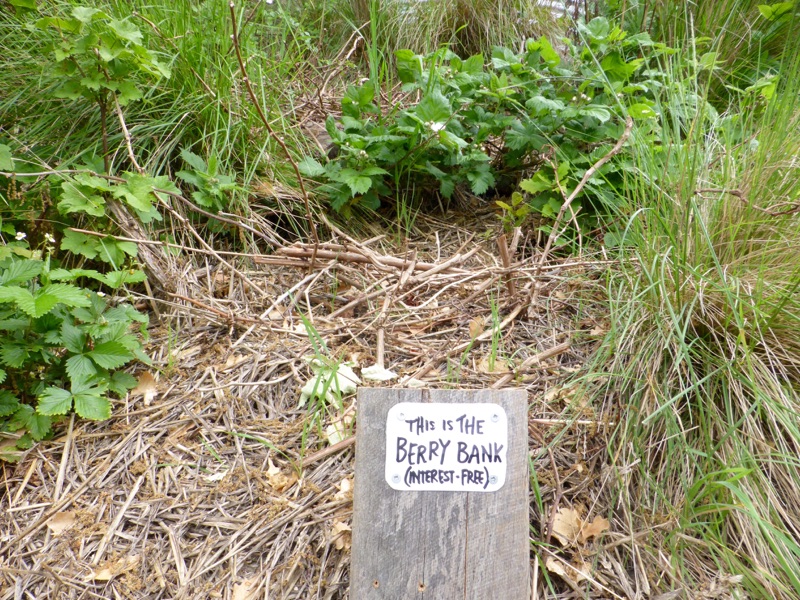
We've also been putting up little signs around the garden to aid the permaculture tour that is coming while we're away and also to help our tenants navigate the garden. Here's a selection:


It's a bit difficult to see how the swale works in the above picture so here's one from 2009 when it first went in. Water travels from our bath/shower along a spoon drain that has been plumbed level across the contour of the land. Water is distributed through 30 metres of food growing garden beds and 'passively' harvested deep into the ground. This is one way to help climate-change proof your garden. The whole system is gravity-fed.


We've also been harvesting our (unprecedentedly early) garlic,


bottling the last of our plum wine,


and much bike tuning.


Then we were off without the anxieties we felt on our first trip, heading east a gentle 22 kms with plenty of stops,


to our first hidey-hole camp in the wonderful Wombat Forest on the edge of Trentham.


We are not going to be blogging here as much over the next three months. We're going to be rather busy getting to 20 book events in 90 days. We will be micro-blogging however on Twitter, Instagram and Facebook, so please join us there @artistasfamily.

Wherever you are Dear Reader, we hope you'll check in with us along the way and share your thoughts, reflections, advice and even botanical knowledge. Which reminds us, does anyone recognise this plant? We came across it on the road between Daylesford and Lyonville.


Tuesday, 20 October 2015

Peddling and pedalling our book

We're taking off in 9 days on a pedal-fuelled book tour, traversing two states and a territory and many more countries than terra nullius would care to comment on.

Click for bigger

Here is our schedule:

Woodend — Friday 30th October 2015 4pm New Leaves Books
Kyneton — Saturday 31st October 3pm Aesop's Attic (2pm foraging walk)
Violet Town — Wednesday 4th Nov 6pm Murrnong Farm
Beechworth — Sunday 8th November 3pm Collins
Albury — Thursday 12th Nov 3pm Dymocks
Tumbarumba —Thursday 19th November 6pm Nest Cinema (5.30pm foraging walk)
Tumut — Saturday 21st November 3pm Night Owl Books
Yass — Wednesday 25th November 5.30pm Yass Library
Canberra — Saturday 28th Nov 3pm Paperchain Books (1.30pm foraging walk)
Bowral — Wednesday 2nd Dec 4.30pm The Moose Hub (as part of Green Drinks)
Sydney — Saturday 5th December 3pm Florilegium (intro by Kirsten Bradley)
Blackheath —Thursday 10 December 5.30pm Gleebooks Blue Mountains
Berry — Saturday 2nd Jan 2016 3pm Our Bookshop and Cafe
Nowra — Tuesday 5th January 3pm Dean Swift Books
Huskisson — Thursday 7th January 3pm Boobook on Owen
Moruya — TBC Moruya Books
Bega — Saturday 16th January 3pm Candelo Books (2pm foraging walk)
Bairnsdale — TBC (f)route + Collins

We look forward to seeing you on the road.

Thursday, 1 October 2015

A day of release

We've been home 9 months and today our book hits the shelves,


as a book, e-book and audio book. 

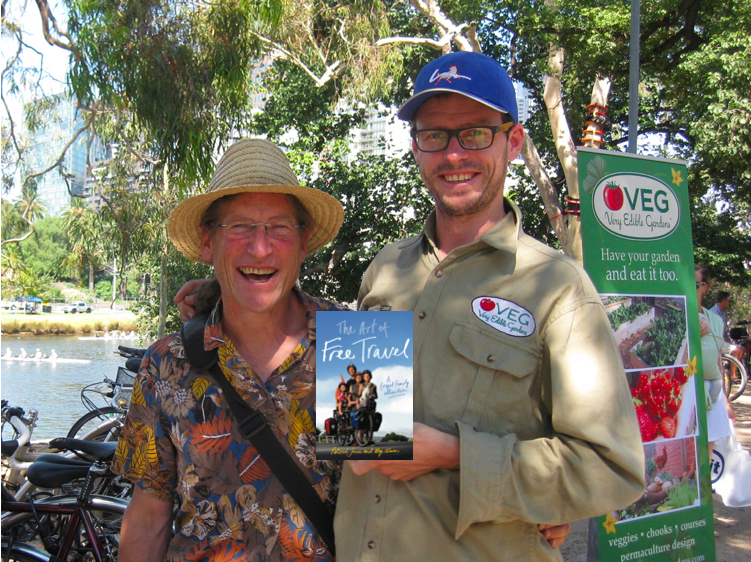
We're launching The Art of Free Travel in both Daylesford and Melbourne so please come by and help us celebrate. David Holmgren (below left) is launching it in Daylesford and Adam Grubb (below right) is launching in Melbourne.


For a sneak peek, here is our book trailer made by our mate Anthony Petrucci:


We hope you enjoy reading or listening to The Art of Free Travel. Stay tuned for news about our forthcoming book tour.

Friday, 7 August 2015

A short essay on the future, by Zephyr (aged 13)

What will my life look like without fossil fuels?

It’s likely there isn't enough fossil fuels to last us for very much longer, especially the way we are using them, so what is the future going to look like? This is the question I've been asking myself over the last few months. 

Jason Clarke, the Australian film and television actor, says "we are most likely going to have to collect our own water, generate our own electricity and grow our own food – and “share, if you will.” To me this says the main money economy will change too. Sharing could play a bigger role in the future, where people help each other more. The Rockefeller family are one of America’s richest families, made rich in part by their financial interests in fossil fuels. Recently the Rockefeller family pulled out their investments in fossil fuels saying they’re too "risky". They are turning to renewable energy because they know they are the future. This has nothing to do with sharing but it does tell us something about what the future might look like? 


Climate change

Climate change, which has largely been caused by fossil fuels, has not been taken seriously enough. What will be the effects if we let human-made climate change get worse? We are already seeing many more extreme weather events. Renewable energy will help. We have got solar and wind power in some areas but it's not enough, everyone needs to be turning to renewables now. We will also need to reduce consumption and live without many things. Germany knows that climate change is a real threat. In 2008 their renewable energy production was at 9%. In 2014 it was around 30%. In ten years time Germany could be powered by only renewable energy. Germany is one of the few countries at the moment seriously trying to adapt to the future. If other countries follow their lead we would have a greater chance of reducing the worse effects of climate change. 


Fossil fuel pollution

Pollution from fossil fuels contaminates natural environments and reduces biodiversity. Low biodiversity makes people sick, produces diseases. Pollution ruins animal’s habitats and their food sources. Pollution comes from cars, factories, toys, toothbrushes, packaging, computers, bikes, etc. Most things that are made today are made by using fossil fuels, so we will be living very differently without them. The benefits for the environment and peoples' health will be huge. 


What will my family do to minimise fossil fuel reliance in the future?

Here’s a list of things we will continue to do:
-Recycle and reuse paper, plastic, steel, timber, clothes, glass and cardboard
-Grow a food garden and keep chickens
-Compost waste and build soil quality
-Capture solar power and keep a low-carbon house
-Capture rain water and use it wisely
-Exchange food with neighbours and community friends
-Be involved in local community gardens and food swaps
-Walk, bicycle and use public transport


In summary

Going back to my original question "what would my life look like without fossil fuels", there may be things that would be difficult, especially if climate change is allowed to fully develop. Perhaps food and other goods would be very expensive. There might not be as many cars and trucks on the road. There might be violent riots against the government and big businesses. The police and the military could have a bigger presence in public places. People may be very hungry. Some could be in great debt and be kicked out of their homes. Then again some may be much better off, they may be able to harvest their own food and renewable energy and not have to pay big business a cent. 

Zephyr Ogden Jones has been an active member of Artist as Family since the collective began in 2009. His previous writing can be read here.

Wednesday, 29 July 2015

Winter forest

The Wombat Forest called us recently, so we dropped our human-centricity and went bush. We walked out from home,


crossed the Wombat Creek,


and came across these little Green skin-heads (Cortinarius austrovenetus).


A little further on we came across the ghost fungus (Omphalotus nidiformis), a mushroom that illuminates the forest at night when we diurnal mammals sleep. For ring-tailed possums, high up in a eucalypt or protected from powerful owls in a newcomer hawthorn tree, they cast a magical light show.


Earthballs (Scleroderma sp.), a type of puffball, were out in great numbers.


None of the day's autonomous finds was edible, so we stuck with spelt stick damper (Zeph's specialty) and gum leaf tea for lunch.


The bush and knowing our small place in it — the joy of insignificance —


restored our housebound senses.

Monday, 6 July 2015

Cold season food and family cloth

The cold months in Daylesford are a time of surprise and pleasure. It has given us much delight, for example, to suck out the bletted jelly from medlars plucked from the tree.


The currawongs have loved them too.


We've been praising walked-for snared rabbit, stewing the flesh, brothing the bones and salting the pelts.


We've been digging up dandelion roots for roasting and brewing into a dark thick coffee. Patrick discusses the full process in the next issue of Pip magazine.


Our goodly neighbours brought us back some fish they'd caught on the coast and we cooked them on coals in the garden, which made us nostalgic for what we loved about living on the road.


We've been hunting common pine mushrooms like these saffron milk caps,


and slippery jacks,


We've been harvesting and drying hawthorn berries for Meg's nourishing herbal infusions (with rosemary, rose hips, elderberries, parsley and fennel).


We've been juicing autumn's cellared fruit and winter's wondrous weeds.


We've been free-ranging the chooks to make sure they are healthy to get them through the sub-zero nights.


We've been finishing off the SWAP* shed, ready for our next guests.


We've been reclaiming our peasant sensibilities with our friend Vasko, herding his sheep on common land as part of an organic land management model.


This is the current land management model: herbicides kill a patch of the nutritious free street vegetable mallow in Daylesford and the toxic residues end up in the local water supply.


One of the big break throughs AaF has made since our last post was to rid our household of toilet paper. We once spent around $260 a year on this unsustainable, forest-pulp product.

Here is our bathroom. Notice anything unusual?


Instead of toilet paper there are numerous cut up rectangles of cloth sitting on the cistern that are used over and over again. We cut this cloth from an old flannelette bed sheet.

In our SWAP* shed we have built a simple composting bucket toilet, note the family cloth here too.


After wiping with a rectangle of family cloth, we simply fold the cloth and put it in a bucket with a lid that sits beside the toilet. Family cloth is much softer than toilet paper and much much easier to process than cloth nappies.


Inside the bucket it is dry. Occasionally we throw in a few drops of eucalyptus oil. It doesn't smell at all (although we may have to adapt the process in the warmer months). We learnt by trial and error that cutting the cloth with pinking shears,


didn't help with the cloth fraying when they went through the wash.


So we bartered a sour-dough lesson with the delightful Mathilda, who beautifully over-locked them.


This is what they now look like up close.


About once or twice a week we put on a hot wash of our family cloth and hang them out to dry.


Thanks boys! And thank you Dear Reader for checking in with us again.

*SWAP (Social Warming Artists and Permaculturalists) is our version of WWOOF (Willing Workers on Organic Farms).