
Tuesday, 27 August 2013


Monday, 19 August 2013
Free food – our new adventure project
We're getting prepared to rent out our house and head off for a year of bike-camping along the east coast of Australia, extending our knowledges of free food that we will forage, hunt and hopefully barter for along the way.
We're loading our most essential tools onto just two bikes that we've recently had converted to electric to help haul on the hills, and we're doing plenty of practice rides before we go.
With successive GFCs looming, climate chaos and the end of cheap crude oil, Artist as Family want to take the gloom by the handlebars and extend our everyday art practice of resource generation and accountability into evermore 'social warming' opportunities. This new adventure will be a kind of biographical nomadism where we will share our experiences weekly (from mid-November), recording recipes, making ecological notes, airing our dirty laundry and generally performing our unique form of art based on our family's idiosyncrasies and taste for permapoesis. At the end of our travels we will compile a book and possibly even stage an exhibition that will include videos, drawings, photos and writings we make along the way. We aim to show that it's possible to live without being entirely dependent on the monetary economy, as we adapt to change and engage further with lean logic.
 |
| Photo: Dave Cauldwell |
 |
| Photo: Dave Cauldwell |
Monday, 8 July 2013
Rent our home for a year
Open plan, double-glazed, solar powered, fully furnished (negotiable), permaculture house and garden in Daylesford, Victoria. Short restorative bush walks to Lake Daylesford and mineral waters and even shorter walks to town. Buses to railway stations for possible car-free living.
Shop for groceries at the Hepburn Wholefoods Collective, walk and bike everywhere, order your organic vegie boxes direct from nearby farms, grow your own food in our garden's delicious soil and/or at one of the community gardens, walk out and camp in the surrounding bushland, shop for clothes at the community op-shop or see the latest films at the community run cinema.
However you want to live, come and trial living in Daylesford for a year. Our home is two bedrooms although the study/office can become a third bedroom. Apart from extensive fruit trees, the garden also features chooks and ducks, a trampoline, rainwater tanks and a dog run. We will remove all personal belongings from the house so as it is as much a neutral space we can provide for you to make your home. However happy to leave plates, cutlery, pots etc...
Shop for groceries at the Hepburn Wholefoods Collective, walk and bike everywhere, order your organic vegie boxes direct from nearby farms, grow your own food in our garden's delicious soil and/or at one of the community gardens, walk out and camp in the surrounding bushland, shop for clothes at the community op-shop or see the latest films at the community run cinema.
However you want to live, come and trial living in Daylesford for a year. Our home is two bedrooms although the study/office can become a third bedroom. Apart from extensive fruit trees, the garden also features chooks and ducks, a trampoline, rainwater tanks and a dog run. We will remove all personal belongings from the house so as it is as much a neutral space we can provide for you to make your home. However happy to leave plates, cutlery, pots etc...
 |
| lounge |
 |
| kitchen and dining |
 |
| main bedroom |
 |
| entrance |
 |
| southside |
 |
| produce |
$350 per week plus bond. Available from Novemember 2013.
Call us for more information or to arrange an inspection: Meg 0418 523 308 or Patrick 0400 897 850.
Monday, 15 April 2013
Tagging, birthing and ploughing radical identities
As artists, homeschoolers, public transportees, community witnesses, friends and as family we travelled to Melbourne today. We arrived early because (by chance) Woody woke us in time to catch the first bus. We walked the drizzly city streets and Zeph bodytagged the laneways, not with toxic paint but with biophysical exuberance.

We lost ourselves in the dreary dreamy morning and only after asking a passer-by for the time did we then run to the County Court to meet our community friends and persecuted midwife, Sally. Sally is another independent midwife hunted by a nanny-state that foregrounds institutional hysteria over feminine intuition, ethics and rights. One of the central arguments against her was that the public needs protection from such risk, yet outside the court the state was ratifying cars, Coke and climate change. Ideologies of mass toxicity and pollution reign in an abuser’s paradise while loving independent midwives are deemed a threat to 'the public'.

Today, Sally’s verdict was basically the final nail in the coffin of her long practice as an independent midwife and marks a further erosion of rights for women. The legal costs and the rulings handed down from the so-called expert panel have made it impossible for her to appeal and keep practicing. A number of us, as representatives of all who love and respect Sally, rose early to travel for a few hours to support her. This is a person who was awarded the highest acknowledgement in our community at the International Women’s Day Honour Roll celebrations two years ago.

Sally’s great mistake was that she spent more time adorning, caressing, heartening and massaging the mothers she cared for and not enough time filling out forms and following a patriarchal-Cartesian regime of risk assessment and legal accountability. All the letters from the mothers of the births under investigation were ignored, and so too the fact that the overwhelming majority of mothers Sally tended were able to birth in the manner that respected their wishes, free from the panic of obstetrics, clock-time and legal risk assessors that shape all decisions a birthing ward makes. If any mothers had written criticism of Sally we’re sure this would have been used against her, but instead all our letters of support relating to her case were blatantly ignored.


Today we thought about those who are persecuted; the likes of Julian Assange, Ned and Sally. All three are bound by a staunch belief in peoples’ basic rights for self-determination. All three share various experiences of homeschooling and all three have been cowardly persecuted by those who wish to control us.

We lost ourselves in the dreary dreamy morning and only after asking a passer-by for the time did we then run to the County Court to meet our community friends and persecuted midwife, Sally. Sally is another independent midwife hunted by a nanny-state that foregrounds institutional hysteria over feminine intuition, ethics and rights. One of the central arguments against her was that the public needs protection from such risk, yet outside the court the state was ratifying cars, Coke and climate change. Ideologies of mass toxicity and pollution reign in an abuser’s paradise while loving independent midwives are deemed a threat to 'the public'.

Today, Sally’s verdict was basically the final nail in the coffin of her long practice as an independent midwife and marks a further erosion of rights for women. The legal costs and the rulings handed down from the so-called expert panel have made it impossible for her to appeal and keep practicing. A number of us, as representatives of all who love and respect Sally, rose early to travel for a few hours to support her. This is a person who was awarded the highest acknowledgement in our community at the International Women’s Day Honour Roll celebrations two years ago.

Sally’s great mistake was that she spent more time adorning, caressing, heartening and massaging the mothers she cared for and not enough time filling out forms and following a patriarchal-Cartesian regime of risk assessment and legal accountability. All the letters from the mothers of the births under investigation were ignored, and so too the fact that the overwhelming majority of mothers Sally tended were able to birth in the manner that respected their wishes, free from the panic of obstetrics, clock-time and legal risk assessors that shape all decisions a birthing ward makes. If any mothers had written criticism of Sally we’re sure this would have been used against her, but instead all our letters of support relating to her case were blatantly ignored.

We left the court teary-eyed and Artist as Family walked soberly to the State Library where we saw an exhibition of another state-made outlaw, Ned Kelly. Homeschooling Zeph has enabled so much more flexibility in our family life, so that learning has become more applied, less abstract and much more relational. We marvelled at Ned Kelly’s armour made from parts of an old plough. This was engineered by a blacksmith evidently sympathetic to the politics of the Kelly gang who were in turn abhorred by the smug ruling elite who had brought class war to what had always been a classless country. In another exhibition we observed an early painting of our home town’s main street, intrigued by the inaccuracy of the painter, and more than aware of the terror Jaara people must have experienced at this time, so picturesquely absent from this civil street scene.

Today we thought about those who are persecuted; the likes of Julian Assange, Ned and Sally. All three are bound by a staunch belief in peoples’ basic rights for self-determination. All three share various experiences of homeschooling and all three have been cowardly persecuted by those who wish to control us.
Sunday, 14 April 2013
Walking a poemline
The joys and trials of our walk to Melbourne... more thinking about post crude oil art forms.
Tuesday, 26 March 2013
Walking for Food
Artist as Family plan to walk for five days to Melbourne from our home in Central Victoria and we wish to do this respectfully acknowledging the elders and traditional communities of the country through which we travel.
We are a carless family and understand how ecological knowledges are foregrounded when technologies are backgrounded. This is our first walk to Melbourne which takes only an hour and a half by car.
We aim to leave Daylesford on March 31 and be at Point Cook or thereabouts on April 5. We aim to walk out from our home in Daylesford in Jaara country through the Wombat Forest, across the Lerderderg State Park, dropping down East of Bacchus Marsh before heading on to Port Phillip Bay.
We will take as little food and equipment as possible and put our foraging/walking/camping knowledges to the test.
The walk is also to celebrate the completion of Patrick’s manuscript, ‘Walking for Food: Regaining Permapoesis’. His book and our walk to Melbourne both attempt to raise issues around food and energy sustainability and environmental ethics. The book heavily quotes Aboriginal voices and sensibilities relating to the respectful treatment of country. This book is the result of three and a half years doctoral research based on our family and community’s transition to local food and energy resources. Patrick has conducted the research in our home community of Daylesford and through the University of Western Sydney.
On the afternoon of April 5 Patrick will give a talk at The Real Through Line poetry symposium at RMIT, a free event open to the public.
We are a carless family and understand how ecological knowledges are foregrounded when technologies are backgrounded. This is our first walk to Melbourne which takes only an hour and a half by car.
We aim to leave Daylesford on March 31 and be at Point Cook or thereabouts on April 5. We aim to walk out from our home in Daylesford in Jaara country through the Wombat Forest, across the Lerderderg State Park, dropping down East of Bacchus Marsh before heading on to Port Phillip Bay.
We will take as little food and equipment as possible and put our foraging/walking/camping knowledges to the test.
 |
| Artist as Family proposed walk April 2013 |
The walk is also to celebrate the completion of Patrick’s manuscript, ‘Walking for Food: Regaining Permapoesis’. His book and our walk to Melbourne both attempt to raise issues around food and energy sustainability and environmental ethics. The book heavily quotes Aboriginal voices and sensibilities relating to the respectful treatment of country. This book is the result of three and a half years doctoral research based on our family and community’s transition to local food and energy resources. Patrick has conducted the research in our home community of Daylesford and through the University of Western Sydney.
On the afternoon of April 5 Patrick will give a talk at The Real Through Line poetry symposium at RMIT, a free event open to the public.
Tuesday, 29 January 2013
When things are easy

and camp

and draw

and feast

and pick
 |
| Karkalla pigface (Carpobrotus rossii) |
and pick
 |
| Bower spinach (Tetragonia implexicoma) |
and hunt

and wash

and walk

and dig

and kill
 |
| Leather jacket (Oligoplites saurus) |
and cook

and feed

and feed

in clear-eye ease.
Saturday, 19 January 2013
An ample leanness (camping with friends)
We walked, bussed, walked, bussed and walked our way from home to the beach to join friends for a camping adventure.

We set up camp and all pitched in under the shade of some grand old cypress trees.

We found out more about the locals,

experienced new sensations,

and wrote a poem about what we understood there.

Then on the last day we all celebrated Meg's birthday and a song was made to mark the day.
Wednesday, 2 January 2013

Friday, 19 October 2012
Introducing
Introducing the newest member of Artist as Family: Blackwood Ulman Jones. Born on August 26, which also happens to be Patrick's birthday. Welcome to the family, Woody!

To introduce him to the earth we thought we would dig a hole in the garden and plant his frozen placenta.

And of course we planted a blackwood tree on top, which the placenta will continue to nourish.

Blackwood wattles (Acacia melanoxylon) are local to cool mountainous climates in Victoria and Tasmania, and thus a tree local to where Woody lives.

Blackwoods are soil builders and companion plants to eucalypts and native cherry (Exocarpos cupressiformis), and named because of their intensely dark wood.

Woody's Hebrew name, עץ גדול (Etz Gadol), means big tree.


To introduce him to the earth we thought we would dig a hole in the garden and plant his frozen placenta.

And of course we planted a blackwood tree on top, which the placenta will continue to nourish.

Blackwood wattles (Acacia melanoxylon) are local to cool mountainous climates in Victoria and Tasmania, and thus a tree local to where Woody lives.

Blackwoods are soil builders and companion plants to eucalypts and native cherry (Exocarpos cupressiformis), and named because of their intensely dark wood.

Woody's Hebrew name, עץ גדול (Etz Gadol), means big tree.

Grow well little Big Tree!!
Wednesday, 5 September 2012
A statement
We have been asked to supply some images and a statement concerning Food Forest for a forthcoming Thames and Hudson publication that surveys ecological art globally. Here's our new statement about the work and an early plan drawing we haven't shared before:

Food Forest is a work that champions biodiversity and demonstrates that materially art can be generative; can be a resource, rather than just an extractor or exploiter of resources. In other words art can be generative contiguous with ecological functioning. Thus this work attempts to blur the line between art and nature. Food Forest is a biological system that is in part self-maintaining. It utilises a combination of applied ecology (mimicking a forest system) and what Artist as Family call 'social warming' (art that makes relationships). It’s a poetic space; a garden that supplies uncapitalised food for a soup kitchen and the nearby community; a physical poem set on publicly accessible church ground; a home to marginalised urban dwellers, wildlife and bourgeois organisms. It is a space to inhabit, to garden, to find solace. Its politic makes a clear departure from typical expressions of nihilistic contemporary art. The work is informed by permaculture utopianism, which has in turn been informed by how traditional communities function as non-polluting custodians of land. The food produced by the work forms part of a local gift economy.

Sunday, 15 April 2012
Good Wood
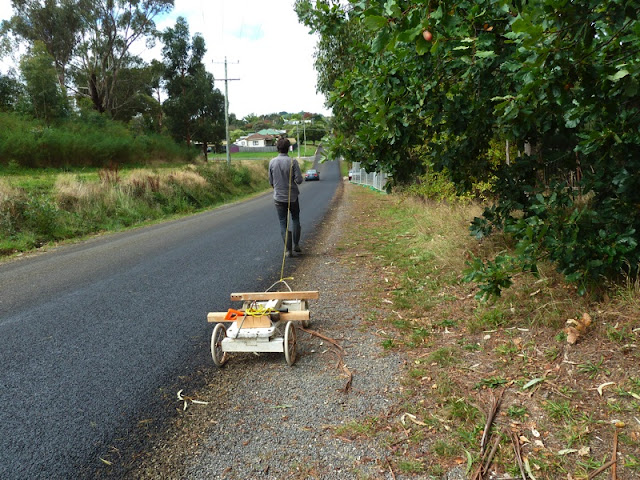
We found some wood, you see. A whole stack of old hardwood batons that were holding up the tiles of a roof that was being retiled in time for the winter rains. The tiler was thrilled when we asked if we could take it, saving him a trip to the tip to dispose of it.
Off we went.


The Daylesford Community Op-Shop is based on a Swedish thrift store model: to provide local community members with what they need including electrical items, so they don't have to shop outside of town or buy new items, and all profits are then put back into the community.

Local not-for-profit organisations can apply to receive the profits for a month. The month of May for example is for Hepburn Wildlife Shelter, which means that they promote that month as theirs. They can bring in their saved-up goods to be sold and their members volunteer at the op-shop.
Based on the size of our town the op-shop is forecast to inject $100,000 a year back into the community.
There's also a community space where mothers can nurse their babies, a book nook, a seed bank and a chai lounge. Pretty amazing, huh?

A brief stop at one of our community food gardens to turn over the compost, and then on we go.

Back home and our day was not quite done. Inside our chicken coop, our birds have been flying over the low fence and have been digging up one of our vegie patches. We have been setting up more substantial fencing over the last few weeks. And after our recent score we finally had enough timber to make some gates.

We harvested the last of the potatoes and Jerusalem artichokes, dug the beds over, added compost and planted them out with heirloom vegies.


And here is the final fruit of our labours: a stack of kindling wood ready for the winter.

Off we went.

'But it's my billy cart, Dad. If you'd like to use it, you have to pull me up the hills.'

'Let's stack the longer bits first and then the small bits.'

Toot toot go the cars as we wobble down the footpath towards home.

A few days later we decided to take the billy cart on another adventure: to our newly opened local community op-shop. In no time at all we had completed our autumn clean-out and had filled five big bags of goodies to recycle.


The Daylesford Community Op-Shop is based on a Swedish thrift store model: to provide local community members with what they need including electrical items, so they don't have to shop outside of town or buy new items, and all profits are then put back into the community.

Local not-for-profit organisations can apply to receive the profits for a month. The month of May for example is for Hepburn Wildlife Shelter, which means that they promote that month as theirs. They can bring in their saved-up goods to be sold and their members volunteer at the op-shop.
Based on the size of our town the op-shop is forecast to inject $100,000 a year back into the community.
There's also a community space where mothers can nurse their babies, a book nook, a seed bank and a chai lounge. Pretty amazing, huh?

A brief stop at one of our community food gardens to turn over the compost, and then on we go.

Back home and our day was not quite done. Inside our chicken coop, our birds have been flying over the low fence and have been digging up one of our vegie patches. We have been setting up more substantial fencing over the last few weeks. And after our recent score we finally had enough timber to make some gates.

We harvested the last of the potatoes and Jerusalem artichokes, dug the beds over, added compost and planted them out with heirloom vegies.


We planted broad beans, three varieties of carrots, kohlrabi, two varieties of beetroot, celeriac, leek and plenty of cabbage.

We are a bit obsessed with cabbage in our household. We love to eat it raw in salads but even more so, we love to lacto-ferment it into sauerkraut. Here is a jar of our latest batch.

And here is the final fruit of our labours: a stack of kindling wood ready for the winter.

Subscribe to:
Posts (Atom)