Showing posts with label Aboriginal country. Show all posts

Thursday, 30 January 2020

All things fall and are built again: a neopeasant response

Fire. One of the most significant phenomenons of this world. Fire makes us human, transports us into technological animals, transforms ecologies, and devastates life when we do not accept its uncompromising feedback.

The seven year old on the right in the below pic is Patrick, joined by his older brother Sam in 1977. They are on a camping trip with their father, Robert. On this night Robert (the photographer) lit a fathering fire after making a fire circle – an early rites of passage for his boys – and cooked a meal.


Four decades later Patrick and Meg light monthly fire circles and gather with community folk to listen deeply to one another and more-than-human life. Each circle, held within the Southwest community forest in the south of Djaara peoples' land, starts with a listening to country. In an unprecedented time of fear, anxiety and aggregating bushfire cycles, these fire circles provide opportunities for collective reflection and care. And for transformation.


While a far greater acceptance and understanding of fire in Australia is required throughout the various non-Indigenous communities, there are things we can do to reduce bushfire risks.

For us, the most obvious things to mitigate bushfires have been to refuse air travel, boycott drought-producing supermarket products, and compost car ownership. Increasingly refusing drought-making economy and tools, has enabled an advancing of our form of neopeasantry, slowly transitioning over the past 12 years, making an immeasurable number of mistakes, which we've converted into an education, and a home.


Five years ago we began taking action in the forest near to us, on the edge of town in one of the most fire-prone regions in the terra-nullius-fiction state of Victoria. We work with neighbours and friends, transforming ourselves into community shepherds.


Our forestry practices marry bushfire mitigation with post-correct biodiversity values. Djaara people, First Custodians to this land, traditionally have managed their country through lores that maintain such a marriage. We've been organising community working bees to remove tyres from the creek,


plant trees,


and herd the most ecologically-sound weeders we know.


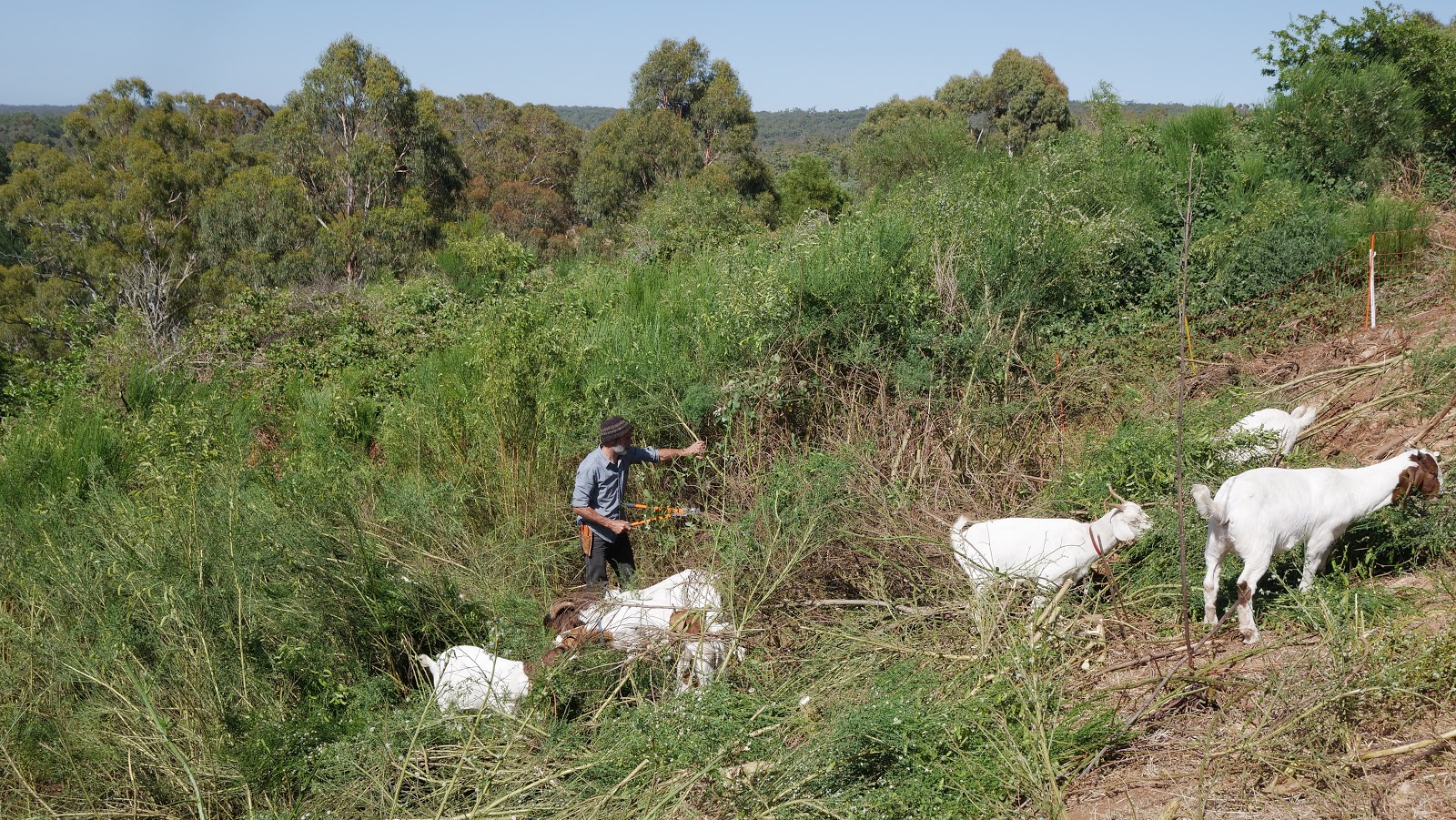
Above are a few of our co-op's goats reducing weeds and bushfire risk at Daylesford Secondary College in the spring. Below are our goats carrying out guerrilla bushfire prevention on the edge of town this summer. Working with animals outside industrial-commercial relations connects us with our animal selves. We become dog and goat people.


Animals. Labouring with animals, being animals, eating and honouring them after fire has cooked up all those acres of medicinal fodder – blackberry, gorse, elderberry, broom, wild apple and oak – connects us to our ancestors and produces relationships of interbelonging between species and with land. To kill for food is sacred work. Whether we pull up a carrot or slit a throat. Souls are transformed. Life and death dance together to make more life possible.


There are always hierarchies, the question for us is whether the ideological order we subscribe to supports ecological hierarchy or mass-death hierarchy? The food we produce is some of the most nutritious money will never buy. Food that has been produced requiring almost no transportation fuels, no deforested pastures, no irrigation, no packaging or additives, and no industry-science laboratories.


Some of our walked-for food is produced by reducing the dominance of pioneer plants and their fire hazards, and in doing so moving ecological succession into the next phase to increase the number of species in the biome. The question of meat or not to meat is not a simply-packaged reductionist exercise, it's an enquiry into ecological, cultural and economic functioning, or dysfunction, depending on what sort of consumer we are.


As ecological eaters and actors on Djarra peoples' country, 100% of our manures – goat, dog, duck, hen and human – go back into the soil to make more life possible. This flow of goodly shit within a closed-cycle and walked-for poop-loop, gives to plants – the great converters of life.

Plants. Forests of trees make rain. An expanding body of evidence supports the idea that forests, in the right conditions, not only make rain locally but also hundreds of kilometres away. Our druidic ancestors held strict tree lores. Druid universities took place in sacred forests. The trees were the professors.

Cultures that remove forests remove rain. Ingenious swidden agriculture grew Mayan cities and civilisation, for a while. As civilisations grow, increasingly more people become urban-centric and thus increasingly estranged from direct connection to land. Thankfully, all city-empires collapse. Ours will too. Cities represent the pinnacle of primitive thought, smugly bound up in ideologies of abstracted culture making, which inside the context of the city appear sophisticated and advanced. When such smugness reaches a tipping point cities collapse, the monocultures that feed the city return to forests or diverse perennial ecologies, rain returns, populations decrease, animism flourishes again.

All things fall and are built again. And those who build them again are gay.

Planting fire-mitigating, carbon-sequestering, shade-producing and moisture-retaining trees is now our emphasis. We're being led by the trees themselves, oldtimer and newcomer species that have established their own inter-indigenous logic on Djaara country – blackwood wattles, English oaks, native ballart, wild apples, sweet bursaria, elder, holly and common hawthorn.


These forests make rain and they retard fires, while producing for us and countless others nourishing food, materials for habitat and more-than-human medicines that the Capitalocene will never access.


Food. There are well meaning people who are always trying to get us to scale up, put our food into a marketplace, subject ourselves to time-poverty, grow our art in capital-career terms, and generally get us to be more real in the realm of the Capitalocene. But what we do is modest, and we recognise that the scale must remain small, intimate, informal, flexible, and it must embrace uncertainty and constant change.


The market demands assurity, which in turn becomes a force against life. Assurity is essentially boring, so the transaction is a boredom in exchange for money, which can buy empty promises to fill the hollowness of modernity. While the spirit and ethic of what we do is free to grow, our household-community economy operates at a scale that enables ecological accountability and market degrowth. If the scale of everything is small, everything is novel, everyday there is a mosaic of labours, which never get boring.


We now know the origin stories of our food,


the medicinal properties of hundreds of plants.


how to turn raw materials into fermented wealth. 


and many processes for making prebiotics, probiotics and postbiotics.


People. An increasing urbanised civilisation produces ever greater enclosure laws. Peasants are kicked off ancestral lands, forests are cut down, ships are built, people once bonded to sacred land become transported slaves who in turn find their way to freedom and join their equally traumatised jailers in dispossessing other indigenous peoples. For the Capitalocene is really the Traumaocene. Healing societal trauma begins with a consciousness of the ruptures and displacements and the severing off from connection to ancestral (loved) land.

While living our ethics and values is foregrounded in forest, garden and community biomes, the political work to protect what's left of the Djaara commons is also important.


We are currently fighting our local council on their proposed revised local laws, which are effectively new enclosure laws being brought onto unceded Djaara peoples' country, drafted by lawyers in Melbourne. One such local law seeks to ban open fires in a public place, on non-total fire ban days. As Patrick argues, this attacks ancient cultural practices. Other laws stop us from salvaging waste, or mitigating bushfire threat. The laws are supposed to make us safer, they often don't. Five people have died in cars in our shire in less than one month and our council is concerned about someone cutting themselves on the metal piles at the local tips while salvaging the waste of the Traumaocene. Cars kill animals, people, poison waterways and stoke up the bushfire gods, yet they are the most protected machines of hypertechnocivility.

In effect the local laws drafted set institutional creep deep into unregulated social life, disabling the status of alternative economies, environmentalism and culturing. A bunch of us are running a campaign to stop this state interference of local governance. We ran a meeting, we put together a website and made submissions, which were recorded and shared publicly.

Then on Invasion day, January 26, we came together to 'fess up to the legal fiction of Terra Nullius.


People make a difference. Four years ago council was livid we established the Terra Nullius Breakfast outside the Daylesford Town Hall, without a permit. If we had asked permission, or applied for a permit, we would have likely been refused. This year council reached out to be involved. We are not Libertarians, but we're not compliant puppets either. We believe in strict lores. We do however baulk at Capitalocene legalism. People make a difference. Unregulated actions change the culture. We all have a role to play in reculturing society from pollution ideology to diverse modes of low-carbon living.


People make a difference. Showing up makes a difference. Grandparents make a difference!


Permaculture scholars and filmmakers make a difference!


Wise forest women make a difference!


People on bikes make a difference!


Walked-for regenerative energy makes a difference!


And forest children (who are Free to Learn and who will never know what NAPLAN means) make a world of difference!


Until next time, Dear Reader, we need to get back to the real work now...


For those wishing to come to one of our two next house and garden tours you can find more info here

If you're just beginning your transition and would like a non-monetary online course in permacultural neopeasantry, start at the beginning of this blog (2009) and read forward, then smash your device and get digging. Working the soil gets you high.

A special thanks to Giulia and Michal, doctoral students currently living with us and sharing knowledges, labour and love. All the better pics in this post are theirs. We love you both and we love living with you.

Monday, 17 June 2019

Towards post-colonial bushfire mitigation practices (using goats and hand tools)...

The Austrian painter Eugene von Guerard painted this in 1864. An early colonial image of the place our privilege calls home.


There was a rapid appearance of European peasant goat grazing, browsing and shepherding upon Djaara peoples' land at the moment when those who spoke old Dja Dja Wurrung tongue, and had survived the prior massacres, sickness and dispossessing intransigence of settlers (backed by the British nee Roman law terra nullius), were being forcibly relocated to Coranderrk.

Due to gold extraction, over grazing and then industrial-era forms of land management the wet gullies and creeks of Hepburn and Daylesford are now infested with woody perennial weeds such as gorse, broom and blackberry. While these plants provide useful ecological services – habitat, food, soil stabilising, etc – their dominance can diminish biodiversity and produce a fire threat each warming summer.

We've been involved in providing a climate-era response to this predicament that may be just more blind colonialism but ironically we think it is potentially a way back to the sort of land management practices of Djaara people. Using goats over a 4-year period as well as sensitive hand tools to diminish the dominance of weedy perennials, we believe we can begin to convert these steep stream ecologies back into perennial indigenous grasslands and ecology that will radically reduce bushfire risk.

As Goathand cooperative, we have just finished a trial collaborating with the Hepburn Shire Council and Federation University and the results are very positive. What we need now for this climate-safe weed and bushfire mitigation project to both upscale and outscale is broader government and community understanding of the succession process that could lead back to the possibility of Dja Dja Wurrung ecological burning processes, which have not been viable because of great stands of 2-3 m dry gorse, broom and blackberries that can climb fire up into eucalyptus canopies.

Below is Goathand cooperative's first film showing the trialling of goats and hand tools. Imagine this scaled up to 200-300 goats (permanently rotating around the shire so as not to overgraze until the dominance of the weeds are treated) and 10-15 human bodies with loppers and pruning saws for a few day's work here and there. The people labour is generally nominal because the goats are so effective, but the human labour and goat interrelationship makes a beautiful marriage (not just pragmatic but one of love) and moves us towards a significant post-industrial behaviour change. Very quickly the town's bushfire risk (Hepburn is one of the most fire-at-risk towns in Victoria) and weed cycle would be greatly diminished and no more glyphosate in our waterways or soil disturbing mechanical treatment or white-fella burning regimes, which all put the weed cycle back at stage one, dry out moisture in the soil and thus causes more fire-proneness. This is not ideal when temperatures are warming.


If you're reading this in your inbox this video will not appear. Head here to watch.

If you're a journo and you'd like to know more about Goathand cooperative, please get in touch.

Monday, 30 November 2015

Giving, taking and making (from Jingellic to Goulburn)

Thank the stars we rested at Jingellic and ate the bounty of local critters the Upper Murray offered,


an idle few days cooking carp on walked-for wood coals and playing songs around the campfire prepared us for the 44 km slog all up hill,


to Tumbarumba. Hello cows! We guerrilla camped for three nights beside the town's creek,


kinda hidden, kinda not.


We were invited to dinner at Geoff and Karen's, who are fourth generation farmers we'd met on the first trip. Respectful debate concerning land use, economies and politics continued from where we'd left off in 2013. Back then Geoff was a climate change skeptic. But no longer.


We held a free foraging class, and identified around twenty species of autonomous edibles,


gathered up the best of what we found and demonstrated how to turn these free gems into desirable food.


We then gave a reading at Nest, and sold a swag of books. Yippee!


We'd heard the ranger was keen to catch up with us in Tumba, so we hightailed it to Batlow and hung out in the library where we met Robert, the town's librarian, who went home at lunch time and picked us a bunch of his glorious asparagus. Thanks Robert!


We were offered a free camp at Greg Mouat's apple orchard with permission to fish out the redfin from his dam. Thanks Greg!


We caught 5 mid-sized ones and added them to Robert's asparagus for dinner, before bunking down for the night.


We stopped in Tumut for a little reading at Night Owl Books,


and took off along the Brungle Road to Gundagai where flashes of the old Wiradjuri spirits collided with newcomer glimmer.


We rode on to Jugiong, made camp again along the Murrumbidgee River where the water was clear enough to go spearing for fish.


Woody and Zero watched from the pebbly bank,


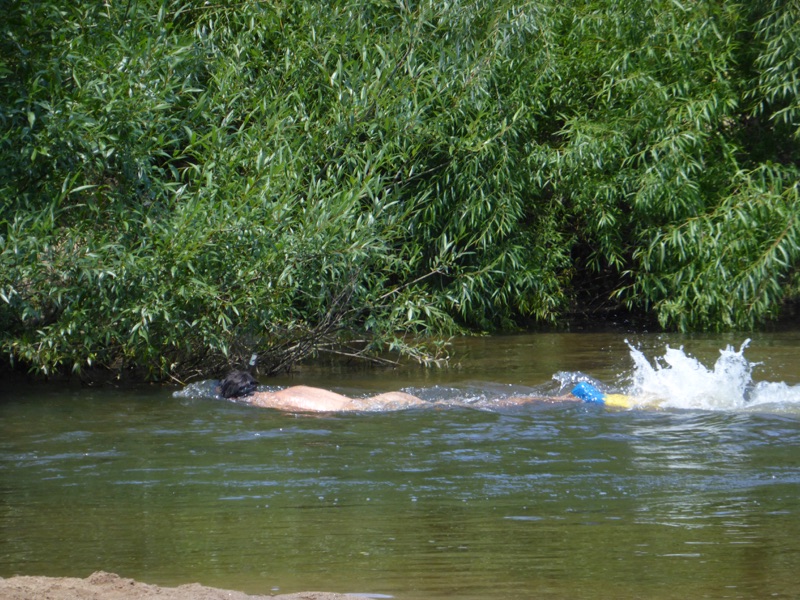
while Meg took a skinny dip.


Patrick was unsuccessful catching fish, but we did harvest stinging nettle and cooked up a bag of this rich-in-iron free medicine with pasta, olive oil, salt and lemon.


We woke to a billy of porridge and hit the Hume Highway.


A tedious, roadkill-marred ride brought us to Bookham for a rest, where two years earlier Patrick had pruned this little feral apple tree. He gave it another prune to encourage a habit for greater fruiting in the years to come. Go little tree, grow!


We schlepped into Yass after a deafening and hot 60 kms, pulled up outside the local land council and had a yarn to Brad, a Ngunnawal man. He told us about a local program set up to rid foxes and feral cats who are, he stated, wreaking havoc on the local tortoise population.


What's remarkable is how many tortoises we've seen killed by cars and trucks since Gundagai. There have been at least 100.


We anthropocenes really are brilliant at kidding ourselves... More lambs; a better environment?


By observing the relationships between other animals —non-mediated earth folk— is it possible to reclaim for ourselves a place as ecological creatures, in relationship and not at war; where one-on-one interspecies killing is part of everyday life, but man-made mass death is not?


Eating a broad, local diet (such as these dianella buds and flowers, soon to be berries), can perhaps aid a process of becoming post-anthropocene. We believe that if we engage in our own resource gathering we can better be accountable to that which makes life possible.


Learning to forage plants that cultivate by themselves, produce food without the need of fossil fuels, mined superphosphate and excessive water inputs all contributes in being able to walk away from the Anthropocene.


We took this merry bunch of Canberra foragers out for a walk in a suburban park and showed them how much food lies just underneath their feet, before returning to Paperchain Books in Manuka for a talk and reading from The Art of Free Travel.


While in Canberra we stayed with an old friend of Patrick's from undergraduate days. Tim treated us to his excellent cooking and a generosity that made us feel like we were back at home. Thanks Tim!


While in the capital we also got to stay with these two kind Warm Showers hosts Kerri-Ann and Michael, who shared their cycling stories and cooked us a lovely meal.


We left Canberra well rested and cared for and rode hard for 70 kms to Tarago to set up an unorthodox camp in their weird but welcoming little public park.


We didn't linger, leaving early the next day for Goulburn where just before we arrived in this old sheep town we spotted fruiting African boxthorn berries to snack on.


We hope the thorns in your fingers, Dear Reader, provide delicious sweets and free delights. One of the lessons we've learned from the road is how the hardships of the day prick the joys, they are one of the same tree.